
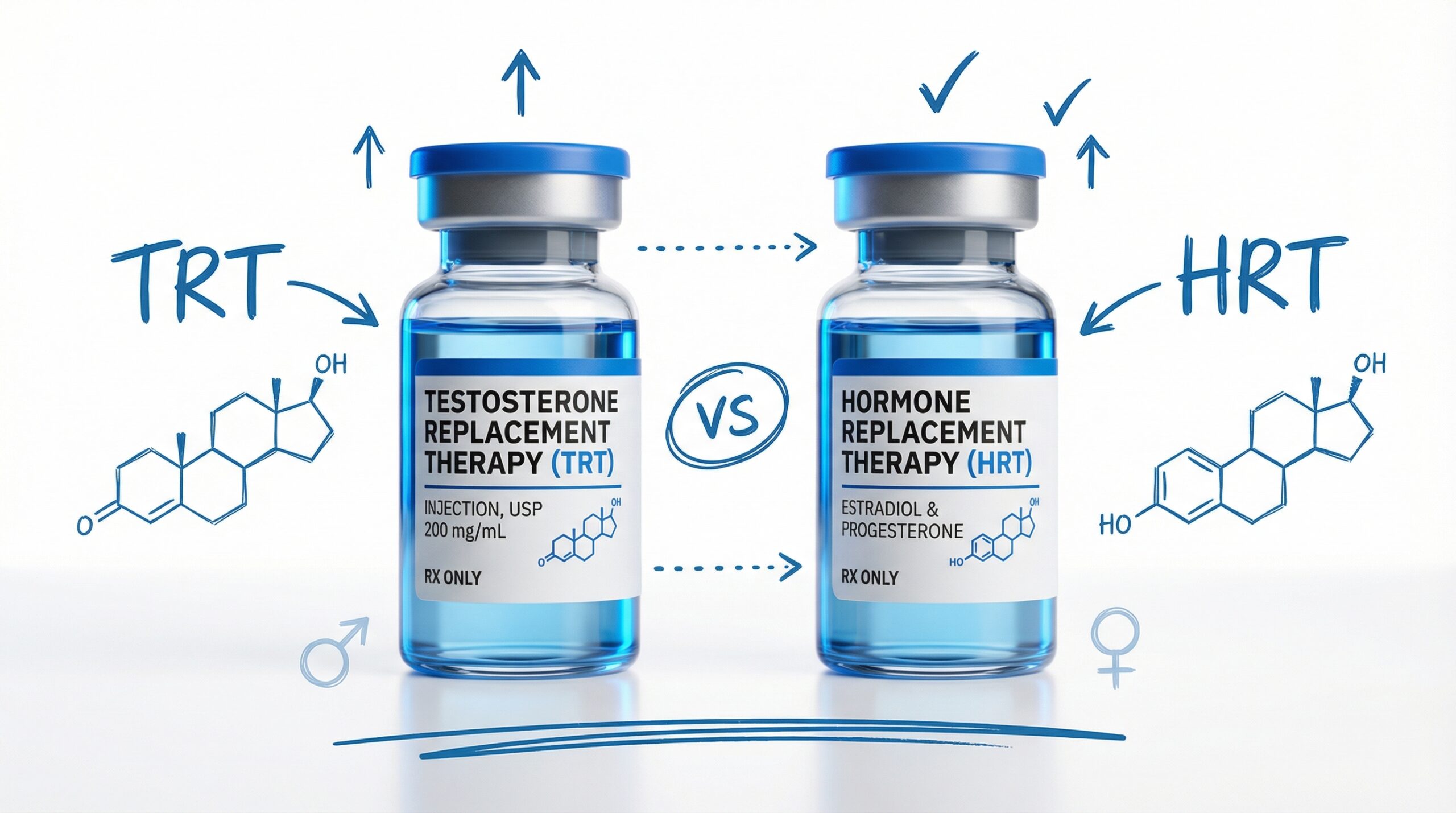
TRT vs HRT: Key Differences Explained for First Responders
You’re sitting in the station, scrolling through Instagram, and every other ad is pushing either TRT or HRT. Your buddy at the gym swears by his testosterone therapy. Your spouse is asking about hormone replacement. And you’re wondering: aren’t these the same thing?
Short answer: No. TRT (testosterone replacement therapy) is a specific type of HRT (hormone replacement therapy). Think of it this way—HRT is the category, TRT is one item in that category. It’s like saying “vehicle” versus “pickup truck.” All TRT is HRT, but not all HRT is TRT.
Here’s what you actually need to know about the difference, who needs which therapy, and how hormone optimization works when you’re dealing with the stress of shift work, irregular sleep, and a job that ages you faster than it should.
What Is HRT (Hormone Replacement Therapy)?
Understanding the TRT vs HRT distinction starts with knowing what each term actually means.
HRT is the umbrella term for any medical treatment that replaces or supplements hormones your body isn’t producing enough of. This can include:
Thyroid hormones when your thyroid is underactive. Estrogen and progesterone for women dealing with menopause. Testosterone for men with low T. Growth hormone in specific medical cases. DHEA, pregnenolone, and other hormones depending on your needs.
The goal of HRT is simple: restore your hormone levels to where they should be for your age and health status. When your body stops producing enough of a critical hormone, you replace it. That’s HRT.
Women typically use HRT to manage menopause symptoms—hot flashes, mood changes, bone loss, and declining energy. Men might use broader HRT protocols when multiple hormones are out of balance, not just testosterone.
What Is TRT (Testosterone Replacement Therapy)?
TRT is a specific form of HRT focused exclusively on testosterone. It’s designed for men (and occasionally women) whose testosterone levels have dropped below the normal range.
Low testosterone affects more than just your sex drive. You’re looking at decreased muscle mass, increased body fat, brain fog, fatigue, depression, and reduced bone density. For first responders and high-stress professionals, low T can hit even harder because chronic stress crushes testosterone production.
TRT replaces testosterone through injections, gels, patches, or pellets. The goal is to bring your levels back into the normal range—not to turn you into a superhero, just to get you functioning like you should be for your age.
What Are the Key Differences Between TRT vs HRT?
Here’s where the confusion clears up. The TRT vs HRT debate comes down to scope and specificity. Let’s break down the actual differences:
Scope of Treatment
HRT: Addresses multiple hormones based on what your body needs. Could include thyroid, estrogen, progesterone, testosterone, DHEA, or growth hormone.
TRT: Focuses only on testosterone replacement. Nothing else.
Primary Users
HRT: Both men and women use HRT, but women are more commonly associated with it due to menopause treatment.
TRT: Primarily used by men dealing with low testosterone (hypogonadism). Women occasionally use testosterone therapy, but at much lower doses.
Medical Conditions Treated
HRT: Menopause, andropause (male menopause), thyroid disorders, adrenal insufficiency, pituitary disorders, and other hormone deficiencies.
TRT: Specifically targets clinically low testosterone caused by aging, testicular issues, pituitary problems, or chronic stress.
Delivery Methods
HRT: Varies widely depending on the hormone—pills, patches, gels, injections, pellets, creams, or intranasal sprays.
TRT: Typically delivered via intramuscular injections, topical gels, patches, or subcutaneous pellets.
Monitoring Requirements
HRT: Requires monitoring of multiple hormone levels and potential interactions between different therapies.
TRT: Focuses on testosterone levels, estrogen conversion, and related markers like red blood cell count and PSA.
Who Actually Needs TRT vs HRT?
Not every guy with low energy needs TRT. Here’s when testosterone replacement therapy makes sense:
You’ve had blood work showing consistently low testosterone (usually below 300 ng/dL, though symptoms matter more than the number). You’re experiencing multiple symptoms: fatigue, decreased libido, brain fog, muscle loss, increased body fat, or mood changes. You’ve ruled out other causes like sleep apnea, thyroid issues, or chronic stress that could be tanking your testosterone naturally.
For first responders, the stress of shift work, irregular sleep, and constant adrenaline can suppress testosterone production. Before jumping to TRT, you need to address the lifestyle factors crushing your hormones.
If lifestyle optimization doesn’t fix the problem and your levels are clinically low, TRT becomes a legitimate medical intervention.
When Do You Need Broader HRT Instead of TRT?
HRT makes sense when you’re dealing with multiple hormone deficiencies, not just testosterone. Common scenarios include:
Women in menopause experiencing severe symptoms that affect quality of life. Men with thyroid dysfunction in addition to low testosterone. People with adrenal insufficiency who need cortisol or DHEA replacement. Individuals with pituitary disorders affecting multiple hormone pathways.
If your thyroid is shot, your testosterone is low, and your DHEA is tanking, you’re not looking at TRT alone. You need a comprehensive HRT protocol that addresses the full picture.
What Are the Common Misconceptions About TRT vs HRT?
Let’s clear up the myths floating around the locker room and social media:
“TRT is just steroids”
Wrong. TRT uses bioidentical testosterone to restore normal levels. Anabolic steroid abuse involves supraphysiological doses (way above normal) to build muscle. TRT brings you back to normal. Steroids push you beyond it.
“HRT is only for women”
Nope. Men use HRT too, especially when dealing with multiple hormone deficiencies. The term got associated with women’s menopause treatment, but it applies to anyone replacing hormones.
“You’ll be on TRT forever”
Usually, yes. If your body isn’t producing enough testosterone naturally and you start TRT, stopping the therapy will drop you back to low levels. That’s not a flaw—it’s how replacement therapy works. Some men can restore natural production with other treatments, but TRT is typically a long-term commitment.
“TRT will make you aggressive”
Not if it’s properly dosed. Bringing low testosterone back to normal range doesn’t turn you into a rage monster. Supraphysiological doses (steroid abuse) can affect mood. Therapeutic doses restore normal function.
“Insurance won’t cover it”
Sometimes true, sometimes not. Many insurance plans cover TRT when medically necessary (clinically low testosterone with symptoms). HRT coverage varies depending on the hormone and the condition being treated. Out-of-pocket costs range widely.
How Does Blueline Wellness Group Approach TRT vs HRT?
We don’t do cookie-cutter protocols. Your hormone panel isn’t the same as the guy sitting next to you in the rig, and your treatment shouldn’t be either.
Here’s how we work:
Comprehensive testing first. We check testosterone (total and free), estrogen, thyroid function, DHEA, cortisol, and other relevant markers. We’re looking at the full picture, not just one number.
Lifestyle optimization before medication. If your sleep is wrecked, your diet is garbage, and you’re chronically stressed, we fix that first. TRT won’t save you from a lifestyle that’s destroying your hormones.
Customized protocols. If you need TRT, we dial in the dose, monitor conversion to estrogen, and adjust based on how you feel, not just lab numbers. If you need broader HRT, we address all deficiencies, not just testosterone.
Access to 60+ peptides. Beyond basic hormone replacement, we offer peptide therapies that support recovery, cognitive function, joint health, and overall performance.
Transparent pricing. $100/month membership gets you access to our protocols and ongoing monitoring. No hidden fees, no upselling, no gimmicks.
Real medical oversight. We’re not a pill mill. You’re working with experienced providers who understand first responder physiology and the demands of shift work.
How Do You Know If You Need TRT vs HRT?
The answer depends on your specific hormone deficiencies and symptoms. Here’s the decision framework:
You might need TRT if: Your testosterone is clinically low, you have symptoms of low T, and other causes have been ruled out.
You might need broader HRT if: You have multiple hormone deficiencies (thyroid, testosterone, DHEA, etc.) or you’re dealing with a complex endocrine disorder.
You might not need either if: Your hormones are normal, your symptoms are caused by lifestyle factors, or you haven’t optimized the basics (sleep, nutrition, stress management).
The only way to know is comprehensive testing and working with a provider who understands hormone optimization for high-stress professionals.
What Are Your Next Steps?
If you’re dealing with fatigue, brain fog, decreased performance, or any of the symptoms we’ve covered, the first step is simple: get tested.
Don’t guess. Don’t self-diagnose based on social media posts. Get a comprehensive hormone panel that shows exactly where you stand.
At Blueline Wellness Group, we specialize in hormone optimization for first responders and high-stress professionals. We understand the unique demands of your job and how shift work, chronic stress, and irregular sleep destroy your hormones.
Ready to stop guessing and start optimizing?
Schedule a consultation with Blueline Wellness Group. We’ll run a comprehensive hormone panel, review your results, and build a protocol designed specifically for your needs—whether that’s TRT, broader HRT, or lifestyle optimization first.
Your hormones control everything from energy to mood to performance. Stop accepting “just tired” as normal. Get tested, get answers, and get optimized.
Contact Blueline Wellness Group today to schedule your hormone assessment and take control of your health.
Frequently Asked Questions
Is TRT the same as HRT for men?
TRT is a type of HRT for men. While HRT traditionally refers to female hormone therapy, men receiving testosterone replacement are technically undergoing hormone replacement therapy. The distinction is mainly semantic—TRT specifically denotes testosterone-only therapy, while “HRT for men” might include multiple hormones.
Can women use TRT?
Yes, some women benefit from testosterone replacement alongside estrogen and progesterone. Women produce testosterone naturally (in smaller amounts than men), and levels decline with age. Low-dose testosterone can improve libido, energy, and muscle mass in postmenopausal women.
How much does TRT or HRT cost?
TRT costs range from $100-$500 monthly depending on delivery method and monitoring frequency. At Blueline Wellness Group, our $100/month membership includes access to protocols and ongoing monitoring—labs and medications are separate. Insurance coverage varies.
Can you stop hormone therapy once you start?
Stopping TRT or HRT is possible but should be done under medical supervision. With TRT, natural testosterone production may not fully recover, potentially requiring lifelong therapy. With HRT, symptoms may return when therapy stops. Gradual tapering is usually recommended.
What age should you start considering hormone therapy?
Age alone doesn’t determine need for TRT or HRT. Men may need TRT in their 30s, 40s, or later depending on testosterone levels and symptoms. Women typically consider HRT during perimenopause (typically 40s) or menopause (average age 51). Symptoms and lab values matter more than arbitrary age cutoffs.